GAME THEORY: IRAN
It is now March of 2026, and our dementia-ridden, pedophile president has continued the republican trend of dragging us into conflicts in the Middle East. Operation Epic Fury (dumbest fucking timeline) will undoubtedly be remembered as the most short-sighted, war of choice the U.S. has ever been involved with. The administration is realizing how ill-prepared they were for this war, which is simultaneously “totally over” and “increasing in intensity.”
Between Trump flip-flopping on “America First,” Hegseth whining about press coverage, and Rubio setting his soulless eyes on Cuba, the one constant in the shitshow that is this administration is that its members are total dumbasses, incapable of developing a long-term strategy, let alone recognizing the need for one.
Why the fuck are we at war with Iran? A question that has many possible answers, both simple and complex. But an easier way to boil it down is by looking at the conflict through the lens of game theory, which strips away partisan talking points, media spin, and state propaganda. This method examines logic, where state actors make decisions based on their own interests, under the assumption others will do the same.
I wanted to quickly break this down using three applications of game theory: the Prisoner's Dilemma, the game of chicken, and understanding the tactics of asymmetric war. Important to note here: Trump is a deranged lunatic who could make things worse at any moment, so I’ve left his lack of control, as well as Bibi’s, out of this analysis for now.
Lastly, what must be remembered when applying game theory is that Iran and the U.S. had a standing nuclear deal that Trump terminated. While the conflict originated decades prior to the Joint Comprehensive Plan of Action (JCPOA), also known as the Iran nuclear deal or Iran deal, the analysis below examines the current state of affairs following the U.S. withdrawal from the agreement.
The Prisoner’s Dilemma: The Nuclear Standoff
The relationship between Iran and the West (primarily the U.S.) regarding nuclear enrichment is a classic Prisoner’s Dilemma.
The Players: Iran vs. the United Nations Security Council + EU (U.S., Germany, U.K., Russia, France, China). Also known as the P5+1.
Iran’s Choices: Cooperate (abide by the JCPOA/nuclear deal) or defect (enrich uranium).
The West’s Choices: Cooperate (lift sanctions) or defect (impose sanctions).
The Logic: Both sides would be "better off" in a state of cooperation (Iran gets trade; the West gets security). However, because neither side fully trusts the other to keep its word, the Nash equilibrium (heyo)—the point where neither side wants to change its strategy—tends toward mutual defection.
The Result: Iran continues enrichment as "leverage," and the West continues sanctions as "pressure."
Game of Chicken
When we see direct escalations—like drone strikes, tanker seizures in the Strait of Hormuz, or missile exchanges—the game shifts to chicken.
The Scenario: Two cars drive toward each other at high speed. The first to swerve is the "chicken" (loses face), but if neither swerves, they both die (total war).
The Strategy: To win, a player must convince the other that they are irrational or have "thrown away the steering wheel."
In Reality: Iran uses "strategic ambiguity" and proxy forces to show it is willing to risk chaos, while the U.S. and Israel uses targeted strikes to show they won't back down. The goal isn't to start a total war, but to force the other side to "swerve" first.
Asymmetric War
Iran often plays a centipede game through its "Axis of Resistance" (proxies like Hezbollah or the Houthis). This is a multi-stage game where players take turns choosing to continue or end the conflict.
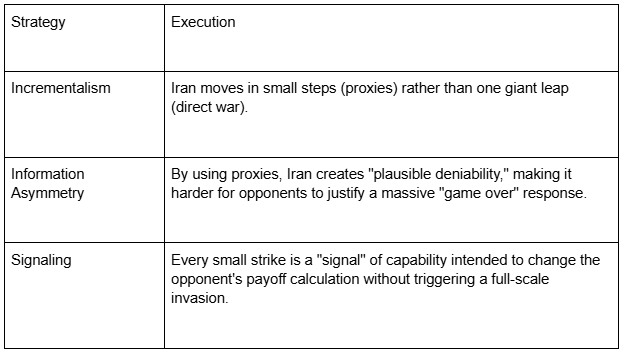
Iran’s Rationality: Survival of the regime is the ultimate payoff. Therefore, seeking a "deterrent" (nuclear or proxy-based) is a logical response to being surrounded by rivals.
Israel/U.S. Rationality: Preventing a nuclear-armed rival is the ultimate payoff, ensuring regional hegemony and national security.
I’ll be the first to admit that game theory sidelines A LOT of intangibles and chaos variables, but I do find its framework useful in setting the stage for the analysis of long-term conflicts. Presidents, supreme rulers, and generals change over time, along with their stated goals or objectives. States’ interests, borders, and international standing, on the other hand, seldom shift with the passage of time. Next time you get in an argument with your significant other, family member, or judge, try applying game theory to the situation to assert your intellect. Let me know how it goes!
-Edited by E. Sullivan